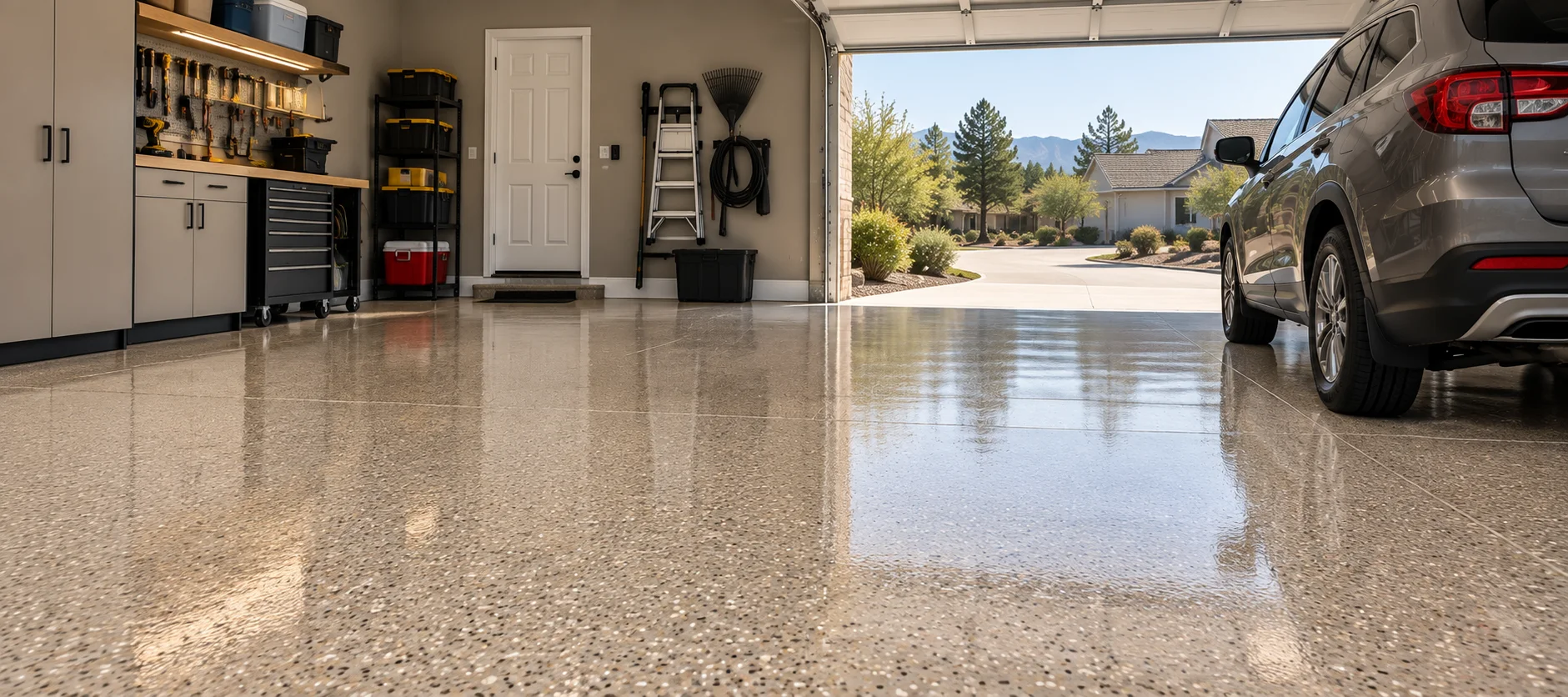
Garage floor epoxy
Garage floor epoxy is the name most people search for, and it covers more than one kind of floor. A professional epoxy floor is a multi-layer system installed on prepared concrete. Many installers also pair an epoxy base with a polyaspartic topcoat.
This guide explains what professional epoxy is, how it compares with hybrid systems and store-bought kits, and what to ask a local installer before you agree to a price.
- $3–$7 Per square foot, a planning range for professional traditional epoxy
- $1,500–$3,500 A planning range for a 500 sq ft floor in professional epoxy
- $6–$12 Per square foot for a flake system with a polyaspartic finish
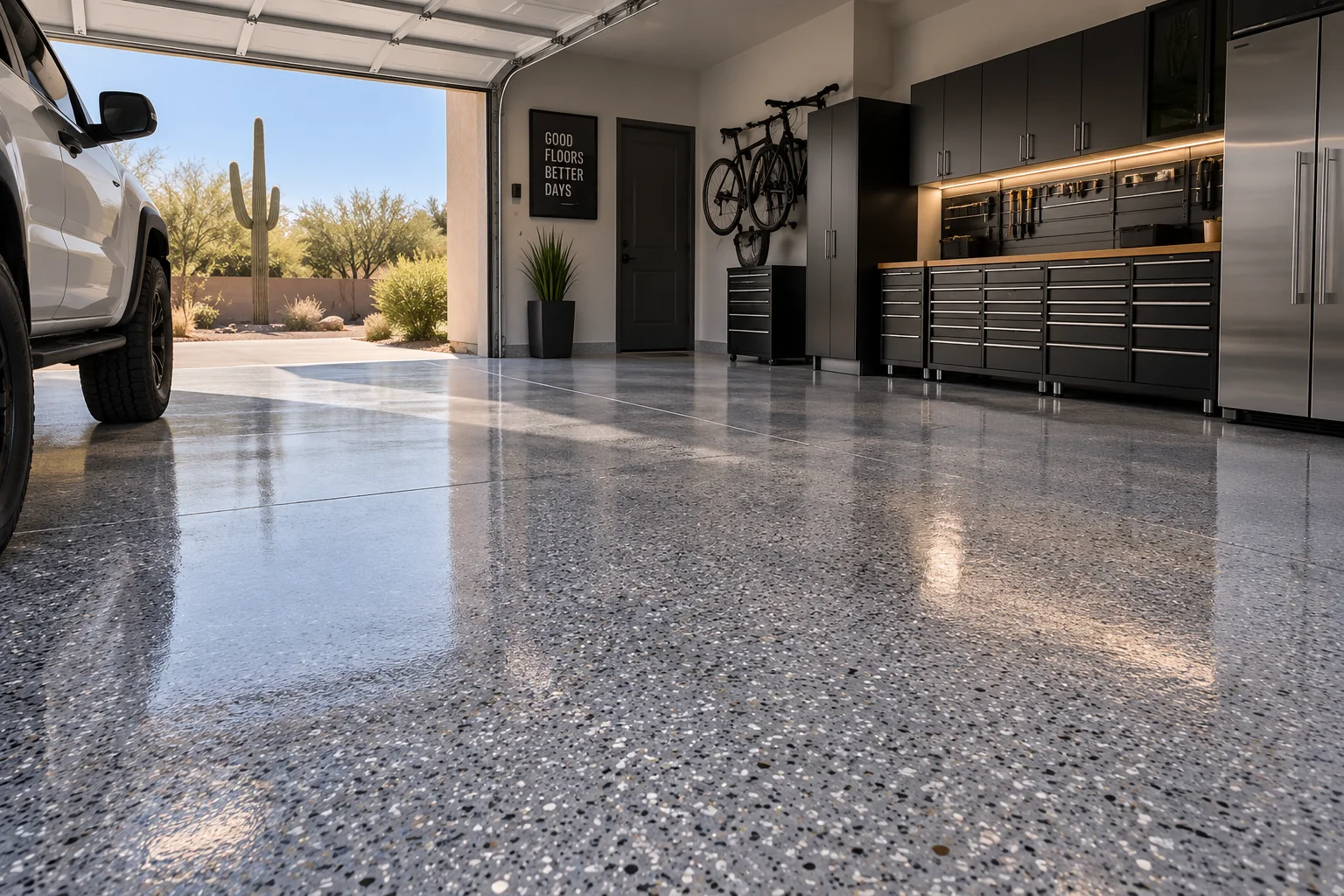
What a professional epoxy floor is
Epoxy is a two-part coating: a resin and a hardener that react once they are mixed. In a professional flooring system, epoxy can play several roles. It can be the primer that bonds to the concrete, the body coat that builds thickness, or the decorative layer that holds color and flakes.
A professional install starts with the concrete. The installer inspects the slab, checks for moisture, old coatings and oil, then mechanically profiles the surface, usually by grinding. That rough, clean surface gives the coating something to grip. Suitable stable cracks and pits are repaired before the first layer goes down.
Professional epoxy is a different product from a thin DIY floor-paint kit. Installed systems use industrial-grade materials applied in compatible layers at a specified thickness, on top of that ground and repaired slab.
Epoxy is also often only part of the floor. Some moisture-mitigation primers are epoxy products, and many installers use an epoxy base under a polyaspartic topcoat. An epoxy base with a polyaspartic topcoat is a hybrid system. It is a separate thing from an all-polyaspartic floor, so ask which layer is which. Our epoxy vs polyaspartic guide goes deeper on the two chemistries.
- Primer or moisture treatment bonds to the prepared concrete
- Body or base coat builds the floor and holds color
- Decorative flakes or the selected finish go on next
- A compatible protective topcoat seals the surface
Professional epoxy, hybrid or DIY kit
All three get called an epoxy garage floor. They are built differently and priced differently. Here is how they typically compare.
- What it is
- Professional epoxy
- Multi-layer epoxy system installed by a professional
- Epoxy base + polyaspartic topcoat
- Epoxy base for bonding and build, polyaspartic finish on top
- DIY epoxy paint kit
- A thin retail floor coating applied by the homeowner
- Surface prep
- Professional epoxy
- Inspection, repairs and mechanical profiling, usually grinding
- Epoxy base + polyaspartic topcoat
- Inspection, repairs and mechanical profiling, usually grinding
- DIY epoxy paint kit
- Done by the homeowner; methods vary by kit
- Sun and UV
- Professional epoxy
- Many conventional epoxies can discolor in sunlight
- Epoxy base + polyaspartic topcoat
- Polyaspartic topcoats are chosen for UV resistance; verify the full system
- DIY epoxy paint kit
- Varies by product; check the label
- Return to use
- Professional epoxy
- Follow the installer's written walk, park and cure schedule
- Epoxy base + polyaspartic topcoat
- Some systems allow one-day installation; follow the written schedule
- DIY epoxy paint kit
- Follow the kit's instructions
- Who stands behind it
- Professional epoxy
- The installer; warranty terms vary by installer
- Epoxy base + polyaspartic topcoat
- The installer; warranty terms vary by installer
- DIY epoxy paint kit
- The homeowner and the kit maker
- Installed planning range
- Professional epoxy
- $3–$7 per sq ft
- Epoxy base + polyaspartic topcoat
- $6–$12 per sq ft with decorative flake
- DIY epoxy paint kit
- Retail kit; not comparable to installed systems
Directional planning ranges and typical traits only. Actual products, layers, timing and price depend on the installer's system, your slab and local costs.
When epoxy makes sense, and its limits
Professional epoxy is a proven option, and plenty of good floors use it. It bonds well to properly prepared concrete and builds a thick, hard layer. Where an installer offers it, a traditional epoxy system is usually the lower-cost route to a finished floor.
Sunlight is the main thing to weigh. Many conventional epoxy formulations can yellow or amber when sun reaches the floor. If your garage door stays open a lot or faces the afternoon sun, ask whether the system has a UV-resistant topcoat. That is a big reason many installers finish an epoxy base with polyaspartic. Our polyaspartic garage floors guide covers that side.
Moisture and prep matter more than the product name. Moisture coming up through the slab, oil contamination or a weak old coating can cause any system to lose its bond. A coating will not fix structural movement, drainage problems or water coming into the garage. See how a full job runs in our installation process guide.
- Mostly shaded garage and a tighter budget: professional epoxy can be a solid fit
- Lots of sun through the door: ask for a UV-resistant topcoat
- Want flake with a faster schedule: ask for a hybrid or polyaspartic quote
- Want flowing, marbled effects: metallic epoxy is available where a specialist installer is
What to ask before you hire
Two quotes that both say "epoxy" can describe very different floors. A written quote should spell out the full system, so you can compare like for like. Price depends on measured area, local costs, the coating specification and the condition of your concrete. Old coating removal, larger repairs and moisture treatment can add cost when your floor needs them. Our garage floor coating cost guide walks through the numbers.
- Which product goes in each layer, and is any of it polyaspartic?
- How will the concrete be prepared, and is grinding included?
- How will you test for moisture, and what happens if you find it?
- Which repairs are included, and which would be quoted separately?
- How does the topcoat handle sunlight?
- When can I walk on it, park on it, and when is it fully cured?
- What does the written warranty cover, and what does it exclude?
Epoxy garage floor questions
What is garage floor epoxy?
A resin coating applied to concrete. Professional systems may use epoxy, polyaspartic or a compatible combination of the two. You do not need to pick a chemistry before requesting an estimate; the installer can recommend a system for your slab.
How much does a professional epoxy garage floor cost?
A planning range for professional traditional epoxy is $3–$7 per square foot, or about $1,500–$3,500 for a 500 sq ft floor. Flake systems with a polyaspartic finish typically plan at $6–$12 per square foot. Your quote depends on area, prep and local pricing. See the cost guide.
Will an epoxy floor turn yellow?
Many conventional epoxy formulations can discolor with sunlight exposure. Ask the installer how the complete system, including the topcoat, handles UV.
Will the coating peel?
Peeling usually traces back to moisture, contamination, poor preparation, incompatible layers or workmanship. That is why prep and moisture checks belong in the main job.
Can new epoxy go over my old epoxy?
The installer has to assess how well the old coating is bonded and whether the new system is compatible with it. Failed coatings may need to be removed first.
How long does installation take?
Some systems allow one-day installation. Repairs, moisture treatment and slower-curing layers can take longer. Walking, parking and full cure are separate milestones, so follow the installer's written instructions. More in our installation process guide.
Is an epoxy floor slippery?
Smooth coatings can be slippery when wet. Slip-resistant options are available, such as texture and additives, and flake finishes add some grip. Ask what fits how you use the space.
Is a professional floor really different from a DIY kit?
Yes. A professional system is built in compatible layers on concrete that has been ground and repaired, and the installer supplies written warranty terms. Retail kits are a separate product with their own instructions.
Find out what your floor needs.
Connect with a local installation professional who can look at your concrete and recommend epoxy, a hybrid or another system, then quote it in writing.